
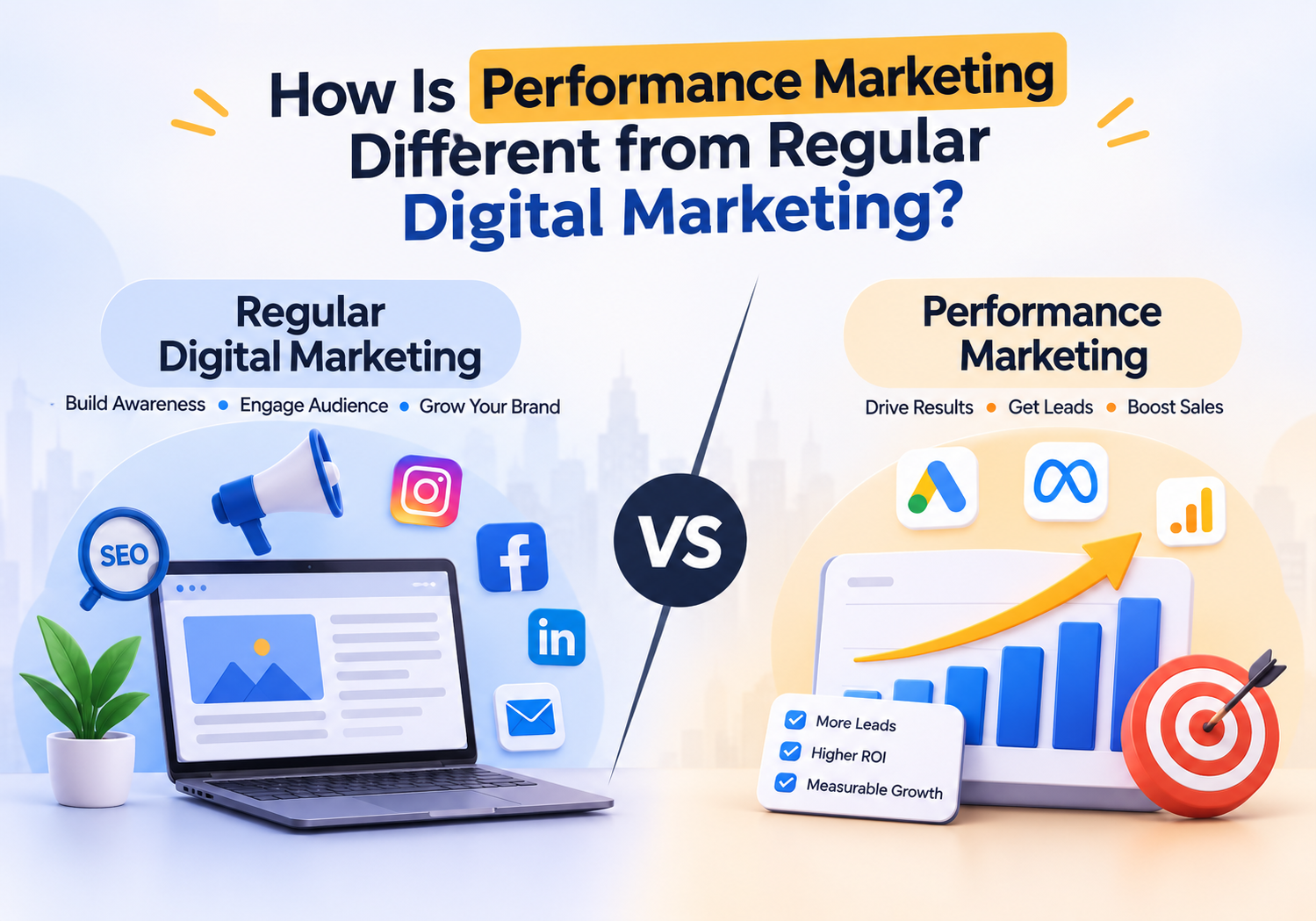
How Is Performance Marketing Different from Regular Digital Marketing?
Digital marketing can help businesses reach consumers online, and every business has a different motivation for doing so. Some wish to expand their brand awareness and customer base. Others want visitors to their site to enquire about a product or purchase. Both of these are a component of digital marketing, but they’re not executed the same way. This is the difference between performance marketing and “regular” digital marketing. One is more about brand awareness and maintaining customer engagement, whereas the other is more about quantifiable initiatives like leads and sales. When you know the difference, you can determine which is right for your business and where to allocate your marketing dollars.
What Is Regular Digital Marketing?
Regular digital marketing encompasses everything that a business does to advertise itself online and communicate with the audience. The primary goal is to get more people to know about the brand, its products and/or services, and remember the brand when they require a specific product or service.
The everyday digital marketing activities include:
- SEO: Optimizing changes to a website that increase its likelihood of being found on Google search.
- Social Media Marketing: Sharing images, videos and status updates with people on social media platforms such as Instagram, Facebook and LinkedIn to maintain people’s interest.
- Content Marketing: Developing blogs, articles, guides and other content that people find helpful.
- Email Marketing: Sending out newsletters, offers, product updates and other updates in emails.
- Online Advertising: Paid advertising used to promote a business, its products or its services.
Let’s take a clothing line, for instance. It might share styling tips on Instagram, publish blogs about the latest fashion trends and work on its website’s SEO. These activities won’t produce sales overnight, but they are great ways of getting more users to know the brand, get familiar with the products and slowly develop trust in the brand.
What Is Performance Marketing?
Performance marketing is about running a campaign for a specific purpose or objective and that can mean more website sales, leads, downloads of an app, or enquiry forms. It is not just like any other type of digital marketing, because it is not limited to the number of people who have viewed an ad. Businesses also consider what happens after the user clicks on an ad and whether they follow through and get results. That’s the reason why performance marketing involves Meta Ads, Google Ads, lead generation, sales campaigns and retargeting so much.
- Facebook and Instagram ads are to target potential customers, while Google Search and Google Shopping campaigns are to target people who are actively looking for a product or service.
- They also leverage conversion tracking tools such as Meta Pixel and Google Analytics 4, enabling them to track website visits, enquiries, and purchases. By testing and optimizing campaigns regularly, you can determine which audiences, ad creatives and budgets are performing better.
Performance Marketing vs Regular Digital Marketing: Key Differences
| Comparison | Regular Digital Marketing | Performance Marketing |
| Main focus | Building brand awareness and online presence | Generating measurable actions such as sales and leads |
| Primary goal | Reaching and engaging a wider audience. | Getting customers to take a specific action. |
| Measurement | Reach, impressions, engagement, traffic and rankings. | Conversions, CPA, ROAS, leads and sales. |
| Platforms | SEO, social media, blogs, email and paid ads. | Meta Ads, Google Ads and other measurable advertising channels. |
| Budget approach | Spending across different marketing activities. | Budget allocation is closely linked to campaign performance. |
How Do Their Marketing Strategies Differ?
Digital marketing generally focuses on:
- Website optimization: Enhancement of the website’s content and keywords for better performance on Google and other search engines, in order to gain organic traffic.
- Creating content for social media platforms, such as Instagram, Facebook and LinkedIn, to boost reach and engagement through sharing reels, images and stories.
- Engaging with Customers: Communicating with current customers via email, newsletters and social media.
- Creation of a consistent Brand Identity: Consistency of visuals, tone and messaging on various platforms.
Performance marketing usually focuses on:
- Testing Ad Creatives: Testing various images, videos and ad copy to determine which ones generate greater responses.
- Advertising: Showing ads to users to drive traffic to a certain product page or a landing page.
- Tracking Results: Keeping an eye on clicks, enquiries, purchases and other conversions to see how things are going with the campaign.
- Optimising Campaigns: Making adjustments to budgets, audience and creatives to enhance performance, according to results.
Which Approach Should Your Business Choose?
| Business Requirement | Suitable Approach |
| Building brand awareness | Regular Digital Marketing |
| Improving Google search rankings | Regular Digital Marketing (SEO) |
| Growing social media followers | Regular Digital Marketing |
| Generating website enquiries | Performance Marketing |
| Increasing online product sales | Performance Marketing |
| Retargeting previous website visitors | Performance Marketing |
| Building long-term customer relationships | Both |
How Can The Bombay Digital Company Help?
Selecting a marketing strategy is just one element of the task. It’s also essential to have the right people working with you who know how to handle it and what your business requires. The Bombay Digital Company (TBDC) is a fully fledged digital marketing company in Mumbai that aid businesses with a variety of digital marketing tasks.
TBDC provides services such as:
| Service | What TBDC offers |
| Growth Marketing | Managing and optimising Meta Ads and Google Ads campaigns to support business growth. |
| Growth Hacking | Exploring ways to generate more leads and sales through advertising campaigns. |
| SEO | Improving website rankings on Google and bringing in organic traffic. |
| Social Media Marketing | Managing social media pages and creating content to keep the brand active online. |
| Content Creation | Creating product photos, videos and promotional creatives for digital platforms. |
| Website Development | Building new websites and improving existing ones based on business needs. |
Businesses can visit The Bombay Digital Company to explore its services and discuss their marketing requirements with the team.
Frequently Asked Questions (FAQs)
Is performance marketing the same as digital marketing?
No, they are not the same; they are both related. Performance marketing is one aspect of digital marketing that is measurable, including sales figures, leads and conversions. Digital marketing encompasses many more activities, comprising social media, content marketing, online advertising and SEO.
Which is better for a small business: performance marketing or digital marketing?
This will rely on the business objective. When the goal is to drive quick leads or sales, performance marketing comes in handy. Regular digital marketing can help achieve the aim of building brand awareness and organic visibility.
3. Is SEO a part of performance marketing?
SEO is normally regarded as part of routine digital marketing. Its results, however, can also be measured in other terms such as organic traffic, enquiries and sales.
4. Which platforms are used for performance marketing?
The platforms generally used are Meta Ads (Facebook and Instagram), Google Ads, and YouTube Ads, among others, which enable companies to monitor the performance of their campaigns.
5. Can performance marketing generate sales immediately?
It can begin to drive clicks, enquiries and purchases shortly after campaigns go live. But it is dependent on the product, audience, competition, the experience of the website and the amount of money being invested in advertising

Leave a Reply