
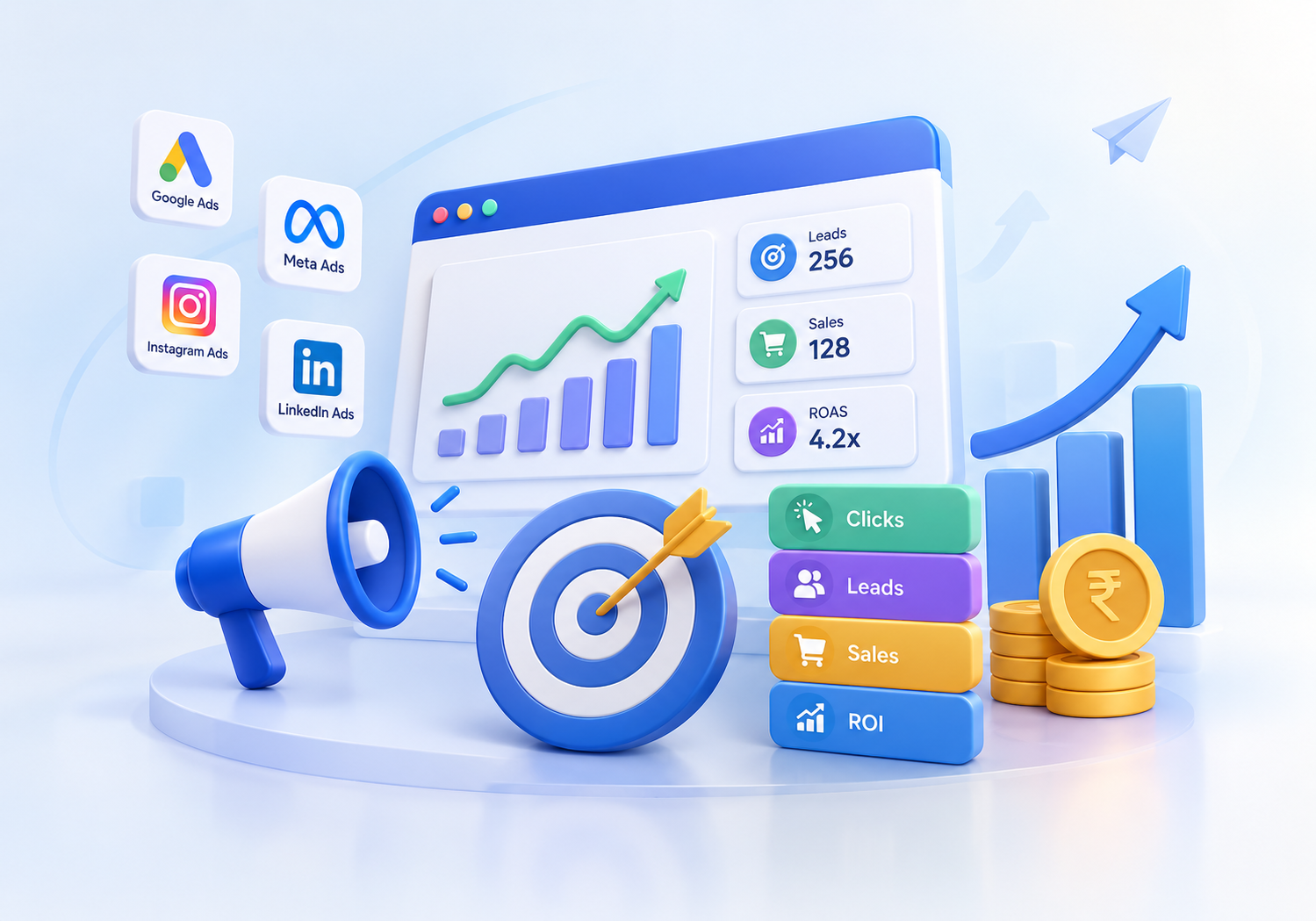
What is performance marketing, How It Works, Channels, Metrics & Benefits
What Is Performance Marketing?
In simple terms, performance marketing is where you measure activity after your ad rather than merely tracking the number of people who see your ad. Rather than merely counting views, you’ll be checking out things such as: did somebody send an enquiry, did somebody purchase anything, did they install the app, did they return to the site again. This is what it’s all about. That “what happens” might be a lead, an enquiry, a purchase, an app install or someone returning to your website.
Suppose a business spends ₹50,000 on ads and receives 100 enquiries from them. They’ll then be able to work out the cost per enquiry, the number that converted to business and what money they have recouped from the campaign. So it’s not that a lot of people saw it, it’s what the spend did. That’s the reason why performance marketing is valuable because it lets you see what your ad spend did for the business and not just how many people viewed it.
How can it grow your business?
Performance marketing can help a business grow, mainly because of how the spending works. Since you’re only paying when something actually happens a lead, a sale, a sign-up- your budget isn’t going toward guesswork. This matters more for smaller businesses that don’t have huge marketing budgets to begin with, because it lets them compete without needing to spend as much as bigger companies. You can put a small amount in, see what actually converts, and then decide where to put more money based on that instead of committing a large budget upfront and hoping it works out.
There’s also the scaling side of it. Once you notice a particular ad or audience is converting well, you have the option to put more budget behind it, and it tends to hold up reasonably well. Alongside that, you end up collecting a lot of data on customer behavior, who’s clicking, who’s buying, where people are dropping off, and that data ends up being useful beyond just the ads themselves. It can inform changes to a website or even a product over time. So the impact isn’t just short-term sales; it also feeds into better decision-making down the line since it’s based on actual numbers rather than assumptions.
How does performance marketing work?
Every performance marketing campaign starts with a simple question: what do you actually want to achieve? Maybe it’s:
- 200 qualified leads
- 100 online purchases
- More enquiries for a specific service
- An extra ₹10 lakh in revenue
- More consultation bookings
- Higher repeat purchases
After this, it is a matter of who you want to contact, what platform will work best, how much you can afford, and which cell phone numbers should be tracked.
Then comes the actual launch. But that’s not really where the effort ends. Most marketers aren’t waiting a few weeks and see how it goes, but are monitoring the metrics as they roll in and making minor changes as they go. Catch it early and it’s a simple fix, wait until the last minute and it’s a poor surprise when the campaign is over.
Performance Marketing vs Traditional Advertising
| Aspect | Performace Marketing | Traditional advertising |
| Goal | Drive specific actions (leads, sales, installs) | Build brand awareness and recall |
| Measurable | Tracked in real time (clicks, conversions, ROI) | Hard to measure directly (reach, impressions) |
| Payment Model | Often pay for results (CPC, CPL, CPA) | Usually pay for airtime/space upfront |
| Platforms | Meta Ads, Google Ads, programmatic, affiliate | TV, radio, print, billboards |
| Targeting | Highly specific (age, interest, behavior, location) | Broad, mass-market audience |
| Flexibility | Campaigns can be adjusted mid-flight | Fixed once published/aired |
| Time Frame for the Result | Fast, often within days | Slow, builds over weeks/months |
| Budget Accessibility | Scalable for small and large budgets | Usually requires large upfront spend |
| Best For | Lead gen, e-commerce, app installs, direct sales | Brand building, mass reach, long-term recall |
Performance Marketing vs Digital Marketing
| Factor | Performance Marketing | Digital Marketing |
| Main Focus | Focuses on measurable actions and business results | Covers a broader range of online marketing activities |
| Goal | Generate actions such as leads, sales, enquiries, or app installs | Build visibility, awareness, engagement, traffic, and sales |
| Measurement | Strong focus on measurable outcomes and campaign performance | Can include both measurable and awareness-based metrics |
| Common channels | Google Ads, Meta Ads, affiliate marketing, paid campaigns, retargeting | SEO, social media, content marketing, email marketing, paid advertising, influencer marketing, and more |
| Budget approach | Often optimized based on campaign performance and results | Budget can be spread across different marketing activities |
What are the main channels used in performance marketing?
There’s no single platform that performance marketing runs on. The right channel really depends on the business and how its customers tend to make buying decisions.
Google Ads
This works well when people are already actively searching for something. If someone types in “digital marketing agency for small business,” they’ve already shown interest; search ads let a business show up right when that happens.
Beyond search, Google Ads also covers shopping campaigns, display ads, YouTube campaigns, and a few other formats.
Meta Ads
Meta is a platform that is more about getting in touch with people based on who they are and their interests, their demographics, their behaviour, and how they have interacted with the business in the past.
If someone visits a site, views a product and exits the site without a purchase, Meta can make it possible to reintroduce that product to them.
Email Marketing
Email does not have to be a thing of the past in performance marketing, particularly when nurturing leads and customers.
It’s like personalized follow-up, talking with people who have purchased in the past, cart abandonment, people who have signed up for an offer, or those that showed interest in a specific thing.
Display and Native Advertising
Display ads are the banners, images and other visual ads you see on websites and apps that you visit. These can be employed for launching a product, informing someone about a brand, or returning visitors who have already been on a website. Native ads aren’t quite the same. They are designed to fit into the content that is surrounding them so that they don’t look like a typical advertisement.
Video Advertising
Video ads are another way of showing a product or service to potential customers. You may encounter them in videos before YouTube, while surfing social media or other site content. They can come in handy when a business wishes to demonstrate a product, clarify a service, or provide a clearer understanding of the brand. Sometimes, a short video is more effective than a static image in explaining a topic.
What Metrics Should You Track?
Running a campaign without checking the numbers can make it difficult to understand whether the money is being spent effectively.
Some of the commonly tracked performance marketing metrics include
Traffic and Engagement Metrics
Cost Per Click (CPC)
This is just what you’re paying, on average, every time someone clicks your ad. Nothing fancy about it. But it’s worth watching if it starts drifting upward over a few weeks; that’s usually a sign your keyword or audience has gotten more crowded, more people bidding on the same space.
CTR (Click-through rate )
CTR (Click-Through Rate) is the ratio of the people who click your ad to those who view your ad. So if 1,000 people see an ad and 50 click on it, the CTR is 5%. Though a good CTR can indicate that the ad is attracting attention, it doesn’t always mean that those clicks will convert to customers.
Conversion Metrics
Cost Per Lead (CPL)
Where this really earns its keep is with businesses that live off enquiries or sign-ups rather than one-time purchases.
CPL = Total Ad Spend ÷ Number of Leads
Customer acquisition cost (CAC)
CAC pushes past CPL a bit further. It’s not just about a form filled out; it’s what it genuinely costs to turn someone into a paying customer.
CAC = Total Acquisition Cost ÷ Number of New Customers
This one matters most when you’re trying to work out whether what you’re spending to get a customer actually makes sense against what that customer’s worth down the line.
Conversion Rate
This is basically the percentage of visitors who follow through and buy something, sign up, book a call, whatever the actual goal happens to be.
Here’s a rough example: say a site gets 1,000 visitors in a month, and 30 of them buy. That’s a 3% conversion rate. Doesn’t sound like much, but even a tiny shift there can move the whole picture more than people expect.
Revenue and ROI Metrics
Return on ad spend (ROAS)
This one sets revenue against what got spent on ads.
ROAS= Revenue from ad spend/ad spend
Say ₹20,000 goes out and ₹80,000 comes back in tracked revenue that puts the ROAS at 4.
But here’s the catch: ROAS on its own can be misleading. It doesn’t account for things like product cost, shipping, staff hours, discounts, or agency fees and those add up fast. A campaign can look fantastic on ROAS and still be barely scraping by once everything else gets subtracted.
ROI (Return on Investment)
ROI tells you whether the money you’re putting into marketing is actually making financial sense. It compares what you spent with what you earned from that investment. For example, if you spend ₹50,000 on a campaign and it brings in ₹1 lakh in profit, you can use ROI to understand the return you’re getting from that spend. It gives you a broader view of whether the money invested in marketing is contributing to the business financially.
LTV (Customer Lifetime Value)
LTV looks at how much revenue a customer can bring to a business over the entire time they remain a customer. Someone might make one purchase and never come back, while another customer might buy from the business several times over a few years. Looking at LTV helps businesses understand the longer-term value of acquiring a customer, rather than judging the customer only by their first purchase.
LTV = Average Purchase Value × Number of Purchases × Customer Lifespan
Example: LTV = ₹2,000 × 4 × 3 = ₹24,000
Why is tracking important in performance marketing?
The goal of tracking is to gauge what occurs following someone clicking on an ad. While the increased click-through rate may seem like a good thing, it doesn’t necessarily mean that people are interested or that the campaign is working. The important thing is what those visitors do after the purchase, filling in a form, signing up, sending an enquiry or taking some other action.
A campaign can receive a lot of clicks and have minimal results. That’s why going beyond the click counts is important. Tracking can tell you how visitors will behave after they come to your site and whether they’ll follow along with the next steps or not.
This can be monitored in a number of ways. Different pieces of information can be found on web analytics, reports on advertising platforms, conversion tracking, CRM records and more. Using UTM links is especially beneficial when determining the source of traffic to a website. UTM parameters also allow you to understand where the visitor came from, such as from a specific platform, campaign, ad or post. Combined with the other tracking information, this provides a comprehensive picture of the post-visit experience.
Is Performance Marketing suited for every business?
Performance marketing isn’t some universal fix that works the same way for every business out there. Whether it’s worth it really comes down to what kind of business you’re running and how customers typically find their way to you. If you’re selling products online, tracking is usually pretty straightforward: visits, enquiries, orders, all fairly easy to see.
There’s also the question of what you’re actually trying to achieve. Want enquiries, bookings, site visits, or straight-up sales? Performance marketing’s built for tracking exactly that kind of thing. But if the goal is more about getting your name out there or building some brand recognition, don’t expect a tidy sales number to show up right away; it just doesn’t work like that.
Then there’s budget, which honestly trips up a lot of people. You don’t need to go all in from day one, but you do need enough to keep ads running long enough to actually gather some data. Too little, and you’re basically guessing there won’t be enough activity to tell what’s actually working versus what needs to change.
Some sales just don’t happen neatly online. Someone sees an ad, checks out the website, mentions it to a friend, wanders into a physical store weeks later, and finally buys. The ad probably nudged that decision along somewhere, but good luck tracing the sale directly back to that one campaign.
So maybe the better question isn’t “does performance marketing work” full stop. It’s whether it actually lines up with your goals, your customers, how they buy, and what you’re able to spend.
Frequently Asked Questions
Is Performance marketing the same as digital marketing?
Not really. Digital marketing is the big umbrella; it includes SEO, social media, email, content, ads- all of it. Performance marketing is just one part of that umbrella, and it’s specifically about things you can measure like leads, sales, or clicks.
Can a new business use performance marketing?
Yes, but expect some trial and error at first. Since there’s no past data to go on, you’ll need a bit of time testing different audiences and ads before you find what actually works.
How much should a small business spend on this?
There’s no set amount. Start with whatever you can afford to test enough to run ads for a few weeks and actually see some results
